Day porter or nightly janitorial: which does your building need
One keeps the building clean. The other keeps it presentable while people are in it. They are not substitutes.
September 15, 2026 · 3 min read
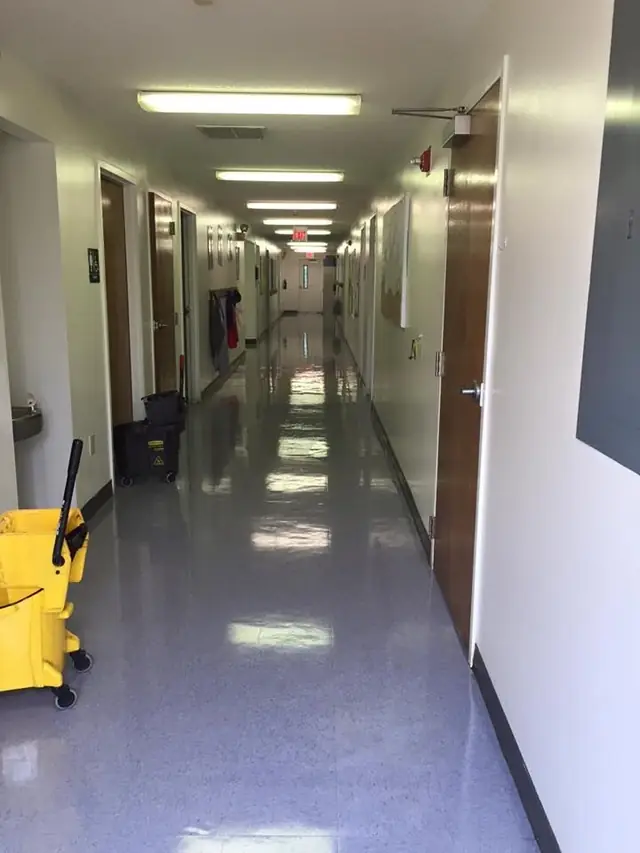
Facility managers often treat day porter service and nightly janitorial as two routes to the same result, and choose between them on cost. They are not alternatives. They solve different problems at different times of day, and picking the wrong one produces a building that is genuinely clean and still looks neglected, or one that looks fine at four in the afternoon and is never properly reset.
What nightly janitorial is for
Nightly work is the reset. With the building empty, a crew can move furniture, do floors properly, service restrooms fully, empty everything, disinfect surfaces without working around people, and give hard floors the uninterrupted time they need.
The advantages are practical. Nobody is inconvenienced, machines can be used without disruption, floors can dry, and the work can follow a consistent sequence instead of being interrupted. This is why most commercial cleaning happens overnight, and why a company doing it properly is reachable around the clock.
Its limitation is equally practical. Whatever happens during the working day stays as it is until that night.
What a day porter is for
A day porter works while the building is occupied, handling what accumulates in real time. Restrooms checked and restocked through the day rather than once. Lobby glass and entrance mats kept presentable. Spills dealt with when they happen rather than eight hours later. Break rooms reset between lunch waves. Conference rooms turned around between meetings.
The value is not deep cleaning. It is that the building holds its standard at the moment people are judging it.
Which one does your building need
The honest test is traffic and visibility. Ask two questions: how many people pass through, and who sees the building during the day.
Nightly janitorial on its own usually suits:
- Standard offices with a stable headcount and mostly internal foot traffic
- Warehouses and distribution facilities where the operational areas are not customer facing
- Buildings where visitors are occasional and expected rather than constant
- Smaller sites where the volume simply does not build up faster than a nightly reset can handle
A day porter earns its cost when:
- The building takes heavy public or client footfall through the day
- Restrooms cannot realistically hold their standard for eight or nine hours
- The lobby is part of how the organization presents itself to visitors
- There are shared amenities like cafeterias or multiple break areas in constant use
- It is a multi tenant building where several parties judge the common areas
Where the real cost sits
A day porter is a person on site for a set number of hours, so the cost scales with those hours and is easy to understand. Nightly janitorial is priced on scope, square footage and frequency.
What is less obvious is the cost of getting it wrong in the other direction. A high traffic building with only nightly service is not cheaper in practice. Restrooms run out of supplies, entrance floors carry the whole day's weather, and the cleaning you paid for stops being visible by mid morning. The work happened. Nobody experienced it.
When the answer is both
Plenty of buildings genuinely need both, and the two are complementary rather than overlapping. The porter holds the line during the day and the nightly crew does the reset, and the hard floor and deep cleaning work sits on its own cycle underneath both.
If the budget will not stretch to both immediately, the usual order is to secure nightly janitorial first, because it is the foundation, then add daytime coverage for the specific zones that need it. A porter covering only the lobby and the main restrooms costs far less than full day coverage and solves most of the visible problem.
How to decide
Walk your own building at two in the afternoon on your busiest day, and look at it the way a visitor would. Check the main restroom, the entrance floor, the lobby glass and the break room.
If what you see is acceptable, nightly service is doing its job and you do not need more. If it is not, no amount of additional nightly work will fix it, because the problem is timing rather than thoroughness. That is the point at which daytime coverage is the answer, and it is worth saying so plainly rather than paying twice for the wrong fix.
Commercial Maintenance Specialist, 704-827-4211
Call 704-827-4211More articles
Carpet sanitizing vs disinfecting: what your office actually needs
The two words get used as if they mean the same thing. They do not, and the difference decides what you should be paying for.
Questions to ask before you sign a commercial cleaning contract
Most cleaning contracts are judged on price because the buyer has no other way to compare them. These questions give you one.